.png)

Overview
The Sylvester Comprehensive Cancer Center is a leading cancer center in South Florida that provides services to a diverse population. To ensure culturally sensitive patient care and understanding of the community, we designed (305) 360° to target incoming health professionals who are unfamiliar with the area's population and culture.
Company: XR Lab & Sylvester NCI
Role: Product manager and UX designer
Team: Rajvi Shah, Noel Nuñez, Geethika Kataru, N'jelle Salmon, Bryson Rudolph, Kim Grinfeder and Natalia Jimenez
Status: Ongoing
My Role
As a product manager and UX designer for (305)360° I was tasked with defining the project scope and developing methods to ensure the project stayed on track. This was especially important throughout the planning process where I was also working towards creating a cohesive and immersive user experience.
User Interviews
Content audits
Product Management
Research
We conducted interviews with doctors in the area as well as Miami locals in order to understand the core needs of the population and how to communicate these needs with our target users.
Key Takeaways
1
Cultural nuances
Miami is a completely different sociocultural experience than the rest of the continental United States and our intended users are not used to it
2
Target users
Our target demographic is not the typical Miamian and is not usually exposed to as many sociocultural nuances.
3
Messaging
The goal is to present Sylvester's catchment area as the future demographic of the United States
Problem Statement
The Sylvester Comprehensive Cancer Center lacks an innovative and engaging learning platform for the Sylvester catchment area. Current methods fail to fully immerse incoming doctors and researchers in the nuances and complexities of the region, hindering their ability to empathize with the people of Miami and its diverse cultural landscape.
General goals
Engage researchers to get excited about the city of Miami
Identify the major factors that influence the cancer burden
in the SCCC
catchment area.
Communicate how the Center has engaged with community members
Tell the story of Miami and its people in an immersive and captivating way.
Proposed Solution
Our team will design and build an immersive virtual reality application to allow doctors and researchers to learn about population characteristics, local personalities and landmarks, demographics, and Sylvester's activities in the community. The application will frame the catchment area as the future demographic of the United States.

.png)
User Personas
The application will employ the use of VR headsets therefore it is assumed that users have a good level of familiarity with technology. While it is assumed that most older users will not have prior experience engaging in virtual environments

Dr. Wesley Smith
From Wisconsin
Motivation: learning about Miami's healthcare system through data
Interests: Data analysis,
public health
Background: recently
moved to Miami from the Midwest.

Dr. Janette Johnson
From Kansas
Motivation: wishes to understand Miami's demographics and her patients' lives better
Interests: Anthropology, cultural sensitivity
Background: recently moved to Miami from the Midwest.
Different medical approaches
Our users have different interests and motivations we should consider
Lack experience
with VR technology
Out target users have not had much exposure to extended reality applications.
User Flow
Because we plan to present this project to healthcare professionals, we decided to create a simplified user flow containing a compressed version of the original user
flow as well, as shown on the right.
Each icon on the chart represents a section
of the experience.

Complete user flow
Ideation and wireframes
Our team drew design inspiration from science fiction technology. The concept of a holographic table allowed the user to manipulate its 3D images with hand gestures to explore the space.
We hoped to transfer this idea to present an interactive map as the table and dynamic dashboards displaying content representing the catchment area. This will provide an immersive experience that will bring these places to life in a virtual space.
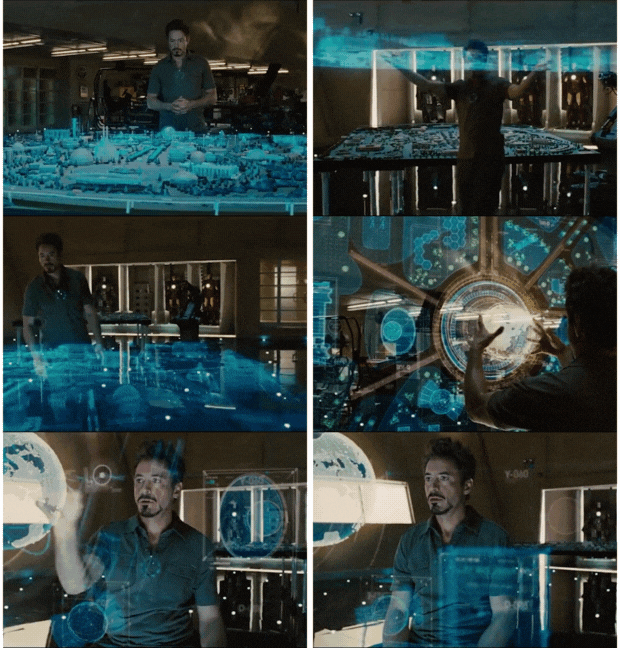
Rapid sketches
Below, are some examples of rapid sketches I created during the brainstorming and researching process. It allowed us to start visualizing the space we were designing in and how the different elements were going to interact with each other.


Digital sketching
These are the sketches that were quickly transferred on to Figma to visualize how these objects would exist in a 3D space.


Implementation
After determining colors and structure I began creating mid fidelity wireframes to perform user testing. Below are some of these wireframes. I designed the layout for the experience in color but experienced some issues with the interaction layout.


User testing
We tested our 2D prototype with potential users. These were the main issues addressed:


Therefore, we went back to wireframing and implemented changes based on the feedback. With these wireframes we hoped to more clearly prototype in a 3D space and create controls and dashboards that would be more suitable for virtual reality. These were
the results:
New icons
We redesigned the main four icons to always exist in the dashboard and on the users' wrists for accessibility and
easier navigation.


New dashboard
The dashboard contracts and expands to reveal the subsections for each category.
Data by zipcode
We selected 24 zip codes to focus on. We found a way to display the information with large graphs and simple infographics.


Interactions in 3D
We had the opportunity to think about how are users were going to move and interact with the space. We came up with intuitive movements and triggers to allow inexperienced users to easily modify their space.
Next Steps
Gather feedback and refine this pitch
-
Create documentation and prototype
-
Sylvester signs off on the documentation
-
Design and development begins
-
Launch in September